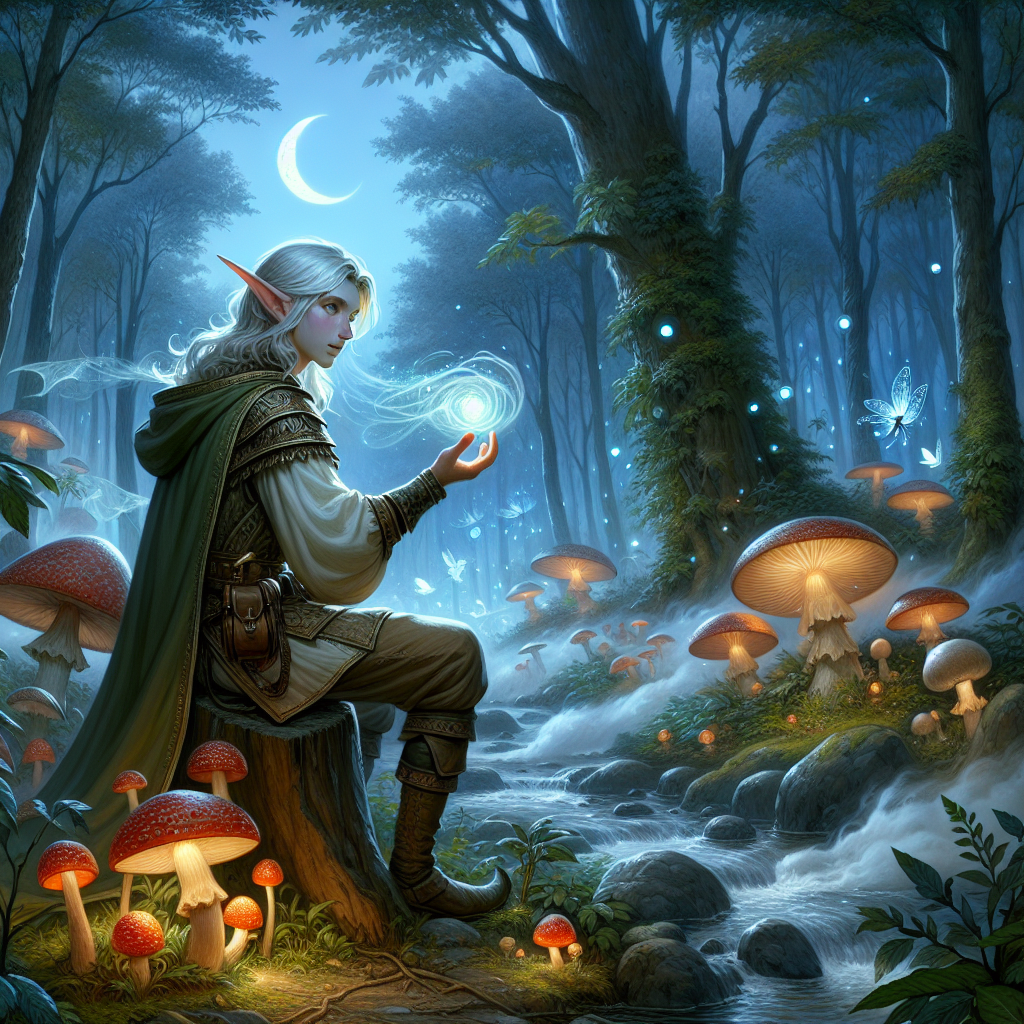
The clearing test: a wood elf name has to be shoutable
High elven names are built to be read aloud in a hall. Wood elf names are built to be shouted across a clearing by someone who has about half a second and a mouthful of arrow fletching. That single functional difference explains almost everything about how the two registers diverge, and it gives you a test you can apply to any name you are considering: say it at speed, at volume, as a warning. If it takes more than a beat, it is a full name and not a use-name.
This is not a rule about beauty. Wood elf cultures in most settings are small, mobile and practical — a band of thirty who all know each other, moving through terrain where being heard clearly matters more than sounding noble. Names in a group like that get worn smooth by use, the same way human nicknames do. A four-syllable name survives on a genealogy; it does not survive a hunt.
So the useful move is not to pick a shorter name. It is to give your wood elf both: the full name their family uses, and the worn-down version everyone actually says. The gap between the two is free characterisation.
The seventeen names in this generator, sorted by the clearing test
Every name below is pool-verified — one of the seventeen hand-checked names this page’s generator actually draws from, not an example written for the article.
1. Use-names — these already pass
Tawaron, Nymira, Zephyra, Faelith, Rilwen, Seraphis, Sylvaris.
Two or three syllables, open vowels, nothing to trip over. These are the names to hand to characters who appear in dialogue often — a scout, a leader, anyone whose name a reader will encounter forty times. Tawaron is the standout for a wood elf specifically: it sits on tawar, wood, and stops after three syllables instead of accreting the endings that would push it into court register.
2. Full names that need a use-name
Faerandel, Merilwen, Thanoriel, Bregolind, Althariel, Lunathiel, Aelorian, Myrindel.
All eight are good names and none of them passes the clearing test. Use them as the formal name and derive the short form yourself — Thanoriel becomes Thano, Althariel becomes Thari, Faerandel becomes Fae, Lunathiel becomes Luna or Thiel depending on which half the character’s people care about. Which half gets kept is itself a worldbuilding decision: cultures that clip the front are telling you the lineage element sits at the start.
3. Wayfinder endings
Elyndor, Cyrandor.
Both carry -dor, the land ending. In a settled high elven house that suffix implies a holding. In a wood elf context it reads differently and more usefully — not land owned, but land known. These are strong names for rangers, guides, border-walkers and anyone whose relationship with a stretch of forest is the point of the character.
The borrowed-root test, and why it matters here more than anywhere else
Four names in this pool are not elvish underneath, and it is worth knowing which, because wood elf naming is where the seams show fastest.
- Zephyra — Greek zephyros, the west wind.
- Sylvaris — Latin silva, wood or forest. Thematically perfect for a wood elf and etymologically from a completely different planet.
- Seraphis — the seraph root again, from Hebrew by way of Greek.
- Lunathiel — Latin luna welded to an elvish -thiel ending.
None of these is a mistake. Borrowing a real-world root is one of the most dependable techniques in fantasy naming, because the reader half-recognises the meaning and the name arrives pre-loaded. The failure mode is mixing registers inside one family or one band. If your scouting party is Sylvaris, Zephyra and Thanoriel, you have quietly implied three unrelated naming cultures travelling together. Pick a lane per group; vary between groups.
The trap: English nature nouns
The most common wood elf naming mistake is not a bad sound, it is a bad language. Leafwhisper, Willowbrook, Moonpetal, Thornsong. They feel appropriate — wood elves live in forests, forests have leaves — and they land as fairy, not elf. The reader parses the English instantly, so there is no residue of the unfamiliar, and elvish names work almost entirely on the residue of the unfamiliar.
If you want a name to carry a forest meaning, do what the pool does and put the meaning in a root the reader cannot immediately translate: silva rather than wood, tawar rather than trees. The meaning still reaches them, just half a second later and without breaking the spell. If you do want compound English nature names in your setting, give them to the fae and let the elves keep their consonants.
Sound palette for the wood elven register
- Liquids do the work. L or r appears in every one of the seventeen names above. They are what makes a name sound like it moves.
- Soft fricatives, not stops. S, th, f, v. Hard k and g clusters push a name toward dwarven or orcish and will fight your setting.
- Shorter than high elven, by design. Two to three syllables for anyone who speaks, four for anyone who is being introduced formally.
- End on a vowel or a liquid where you can. Nymira, Zephyra, Rilwen, Elyndor. Names ending in a hard consonant read as clipped, which is a fine effect for an outsider and an odd one for a member of the band.
Names that change — the wood elf’s best worldbuilding hook
Because wood elf names are functional rather than ceremonial, they are the branch where an earned name makes the most sense. A workable three-stage model you can drop straight into a campaign:
- A child-name, given by a parent and quietly retired — often the softest of the three, and often the one a sibling still uses to needle them.
- A use-name, which is whatever the band wore the child-name down into. This is the one on the page ninety percent of the time.
- An earned name, attached to a specific thing that happened. It does not have to be flattering, and it is more interesting when it is not.
Generate a name from the pool, decide which of the three it is, and you have implied the other two without writing them. That is a fully realised character in under a minute.
Where to go next
If a wood elf is not the right fit, the neighbouring pages start from different premises: the elf name generator explains which elvish name elements are genuinely Tolkien’s and which are later drift; the high elf name generator works from formal court names and the claims they make; the half-elf name generator covers characters standing between two naming cultures. For the world around the band, try the forest name generator for the wood they patrol, the ranger name generator if the class matters more than the species, and the races index for everything else.
Common questions about wood elf names
How many names does this wood elf name generator have?
Seventeen, and they are the seventeen listed and explained above. It is a curated pool rather than an endless random string builder, so every name has been read and checked by a person. The honest trade-off is that names repeat if you keep clicking.
Do I need an account or an email address?
No. There is no sign-up, no email gate and no paid tier. Generate, click a name to copy it, and star the ones you want to keep for the rest of your session.
What makes a wood elf name different from a high elf name?
Function. Wood elf names come from small mobile groups where a name has to be said fast and heard clearly, so they run shorter and get worn down by use. High elf names come from court cultures and are built to be spoken formally in front of other people.
Why do so many wood elf names sound like nature words?
Because several are built on real-world roots for exactly that reason — Sylvaris on the Latin silva, for instance. The technique works as long as the root is not modern English. Compound English names like Leafwhisper read as fairy rather than elf.
Can I use these names in a published novel or commercial game?
Yes. Personal names are not protected by copyright, and this pool is deliberately kept clear of names belonging to specific published characters.
Should a wood elf have more than one name?
It is the branch where it makes the most sense. A child-name, a worn-down use-name and an earned name give you three relationships for the price of one, and you only ever have to write one of them down.